
The Ultimate Guide to Gear for Wedding Photography
If you want to be a great wedding photographer, you need a kit you can trust. It’s that simple. Your essential gear for wedding photography always starts with two camera bodies, the "holy trinity" of lenses (that’s your wide-angle, standard, and telephoto zooms), and a lighting setup that can handle anything. This is the core foundation that prepares you for every single moment, from quiet vows to a wild reception.
Your Essential Wedding Photography Gear Checklist
Walking into the world of wedding photography gear can feel overwhelming. There are a million options, and everyone has an opinion. But here’s the truth: the foundation of any pro's bag is built on three things: reliability, versatility, and being prepared for literally anything. Your gear isn't just a bunch of tools; it’s the promise you make to a couple that you won’t miss a single moment of their once-in-a-lifetime day.
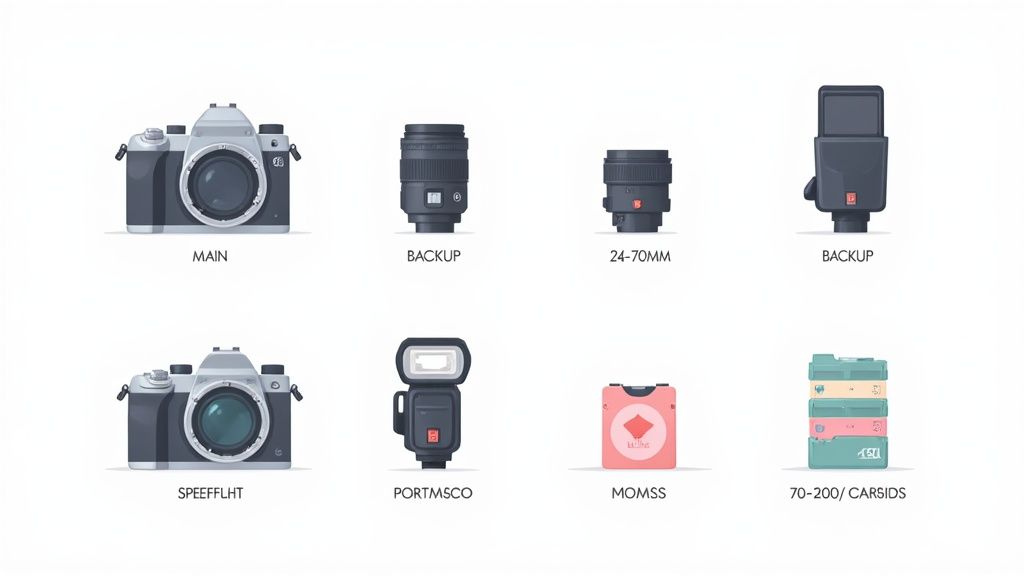
This checklist cuts through the noise. It’s all about the non-negotiables that form the backbone of a professional setup. Think of this as your starting point for building a kit that gives you—and your clients—total peace of mind.
The Core Components of a Pro Kit
The global wedding photography market is a massive USD 26.1 billion industry for a reason. Couples want incredible photos, and that starts with the right equipment. DSLRs and mirrorless cameras are king because they deliver the sharp, stunning images that everyone expects.
At the heart of any pro kit, you'll find these key pieces:
- Two Reliable Camera Bodies: This is non-negotiable. Seriously. If one camera fails, you need a backup ready to go instantly. No excuses. It also lets you keep different lenses mounted, so you can switch between a wide ceremony shot and a tight emotional moment in a split second.
- The "Holy Trinity" of Lenses: This classic trio—usually a 24-70mm f/2.8, 70-200mm f/2.8, and a wide zoom like a 16-35mm f/2.8—gives you the power to capture everything. You can get grand scenic shots, candid group photos, and intimate close-ups without ever missing a beat.
- Dependable Lighting: Wedding days are unpredictable. You could be in a sun-drenched garden one minute and a dimly lit reception hall the next. Having at least one on-camera flash and a simple off-camera flash setup gives you complete control, no matter what the light is doing.
A well-prepared photographer doesn't just react; they anticipate. Your gear needs to be ready for the planned moments and all the beautiful, unscripted ones that truly make a wedding day special.
Before we move on, let's quickly summarize the absolute must-haves for any wedding photographer's bag.
Core Wedding Photography Gear at a Glance
| Gear Category | Primary Function | Why It Is Essential |
|---|---|---|
| Two Camera Bodies | Primary & Backup | Murphy's Law is real. A backup body is your insurance against gear failure, ensuring you never miss a shot. |
| "Holy Trinity" Lenses | Versatile Coverage | This trio (wide, standard, telephoto) lets you capture every scene, from epic landscapes to intimate portraits. |
| Lighting (Flash/Strobes) | Light Control | You need to be the master of light in any environment, from bright sun to dark reception halls. |
| Memory Cards & Batteries | Power & Storage | Running out of either is not an option. You need more than you think you'll need. Always. |
| Durable Camera Bag | Protection & Transport | Your gear is your livelihood. A good bag keeps it safe, organized, and easy to carry on a long day. |
This table covers the bare minimum. Without these items, you're not just unprepared—you're risking your reputation.
The Unsung Heroes of a Wedding Day
Beyond the big-ticket items, your success really hinges on the small stuff. I'm talking about the batteries, memory cards, and straps that keep you shooting smoothly all day long. These are the true unsung heroes of your camera bag.
For a much deeper dive into organizing all this, check out our guide on essential wedding photography checklists, which lays out everything you need to pack and prep. Find it here: https://www.wedpicsqr.com/blog/wedding-photography-checklists
Having a solid plan is just as critical as having the right gear. And while you're focused on the photography, it doesn't hurt to understand the broader event setup. Knowing about the various types of event equipment used at weddings can help you anticipate challenges at different venues.
Ultimately, this foundational kit is your key to capturing memories flawlessly and building a killer reputation in a competitive industry.
Choosing Your Cameras and Lenses
Let’s get down to it. Your camera and lenses are the heart of your entire operation. They’re the tools you’ll use to turn those quick, fleeting moments into something that lasts forever. Forget the spec sheets for a second; we’re going to talk about how this gear actually performs on a chaotic, beautiful wedding day.
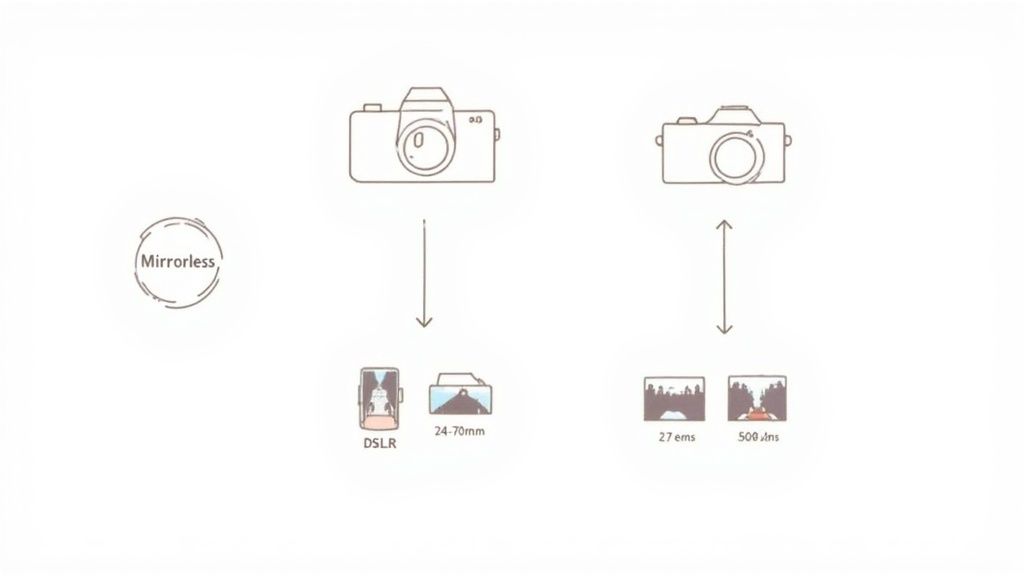
The very first fork in the road is choosing between a DSLR and a mirrorless camera. Both can take gorgeous pictures, but the way they operate makes a world of difference for a wedding photographer.
DSLRs (Digital Single-Lens Reflex) are the old guard. They have a physical mirror that flips up to let light hit the sensor, which is what creates that classic clack sound with every photo. They’re built like tanks and their batteries seem to last forever.
Mirrorless cameras are the newer kids on the block. They ditch the mirror entirely, sending light straight to the sensor. This allows for a completely silent electronic shutter—a feature that is an absolute game-changer during the quietest parts of a wedding.
The Mirrorless Advantage in Sacred Spaces
Picture this: the couple is exchanging vows in a hushed, historic church. You can hear a pin drop. The last thing you—or anyone else—wants to hear is the clack-clack-clack of your camera shutter echoing off the walls. This is where mirrorless cameras aren't just a preference; they're a professional necessity.
That silent shutter lets you capture raw, unfiltered emotion without making a scene. You can get that tight shot of a tear rolling down a cheek or a secret glance between the couple, all while being a ghost in the room. Blending in isn’t just about being polite—it’s a mark of a pro that clients and officiants will thank you for.
Key Takeaway: While DSLRs are true workhorses, the silent shutter on a mirrorless camera is a massive advantage for wedding photography. It allows you to capture intimate moments without disrupting the ceremony.
Plus, the electronic viewfinder on a mirrorless camera shows you exactly what your final image will look like in real time. Exposure, white balance, depth of field—it's all right there. That means less time spent chimping (checking your screen) and a much faster, more efficient workflow when things are moving fast.
Turning the "Holy Trinity" into Storytelling Tools
Okay, let's talk glass. Your lenses are what truly shape the story. The "holy trinity"—a set of three killer zoom lenses—is the industry standard for a reason. It gives you the power to handle almost any situation a wedding can throw at you.
Here's how to think about each lens as a storytelling tool:
- The Scene-Setter (24-70mm f/2.8): This is your workhorse. It’s wide enough to grab sprawling venue shots and tight enough for candid moments. Think of it as your director’s lens, perfect for establishing the scene and giving context to the day's events.
- The Portrait Artist (50mm f/1.4 or f/1.8): While not a zoom, a "nifty fifty" prime is a must-have. That wide aperture melts backgrounds into a beautiful, creamy blur (bokeh) that makes your subjects pop. This is your go-to for those romantic, intimate couple portraits where nothing matters but their connection.
- The Secret Weapon (70-200mm f/2.8): This telephoto lens is your ticket to capturing genuine moments from a distance. You can zoom in on a parent’s emotional reaction during the vows or catch laughter during speeches without ever being noticed. It’s like having a front-row seat from the back of the room, preserving the realness of the moment.
Building Your Lens Arsenal for a Complete Narrative
A wedding day is a story with a beginning, middle, and end. Your lens kit needs to be able to tell the whole thing, from the quiet getting-ready moments to the wild energy of the dance floor.
If you're just starting, get a versatile zoom like the 24-70mm f/2.8. It will probably live on one of your camera bodies for 80% of the day. It’s the Swiss Army knife of wedding lenses.
Next, add a fast prime lens like a 50mm f/1.4 or an 85mm f/1.8. These lenses are absolute beasts in low light and are second-to-none for creating those dreamy portraits. They also force you to move your feet and be more intentional with your compositions, which often leads to stronger, more artistic shots.
Finally, the 70-200mm f/2.8 rounds out your core kit. It’s non-negotiable for ceremonies in large churches or venues where you can't get close. By building your lens collection around these storytelling roles, you’ll always have the right tool for every emotional beat of the day.
Mastering Light With Flashes and Modifiers
Let's be honest, the best photographers have a secret weapon: they don't just find good light, they create it. A wedding day is a gauntlet of lighting challenges, from the harsh, unflattering sun at noon to a reception hall that feels more like a cave. Your ability to bend light to your will is what separates a decent snapshot from a professional photograph. This is where flashes and modifiers earn their keep in your gear for wedding photography.
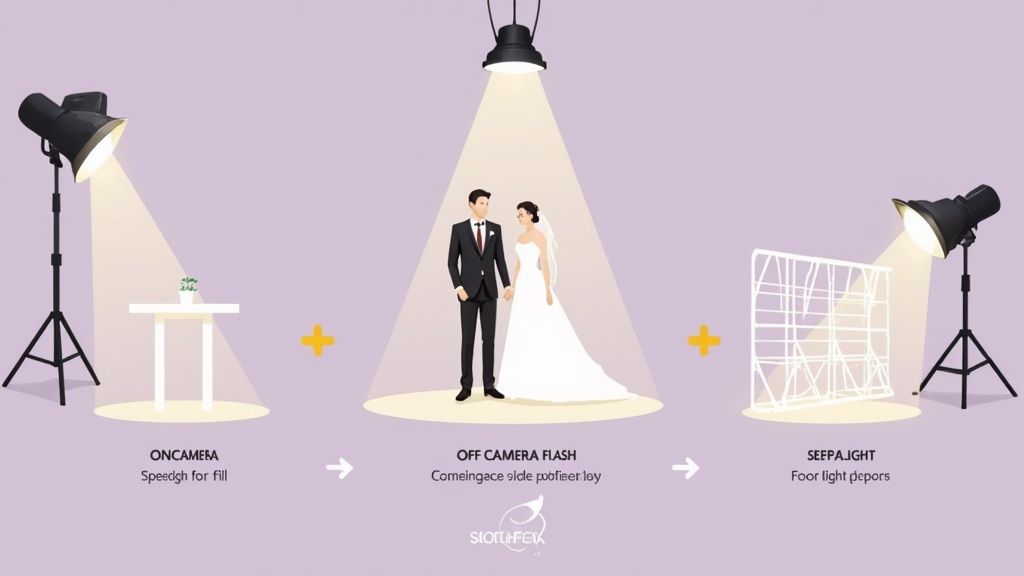
Simply relying on the available light is a gamble you can't afford to take. With a solid lighting kit, you can walk into any venue, at any time, and know you can deliver stunning, consistent images. You stop reacting to the environment and start commanding it.
The Power of Two Speedlights
At the absolute minimum, your bag needs two speedlights (those portable flashes that sit on your camera). This basic setup opens up a whole universe of creative options that a single on-camera flash just can't touch. It’s all about having versatility and control.
Here’s how this dynamic duo works in the real world:
- Flash One (On-Camera): Think of this as your run-and-gun light. Mounted on your camera, it’s perfect for capturing wild moments on the dance floor. You can tilt and swivel it to bounce light off a ceiling or wall, creating a much softer, more flattering light that fills the room without blinding everyone.
- Flash Two (Off-Camera): This is your secret artist. You pop this flash on a light stand and place it anywhere you want to create depth, drama, and that slick, professional look. It’s what you use to separate your subjects from the background and add a cinematic quality to your shots.
This two-light system is your foundation for tackling almost any lighting problem a wedding throws at you. For a deeper dive into these concepts, check out some essential wedding photography lighting tips in our guide.
Demystifying Light Modifiers
A bare flash is harsh and ugly. Light modifiers are the tools you attach to your flash to shape, soften, and direct that light. They're like the different paintbrushes for a painter.
Let's break it down with a simple analogy:
A softbox is like having your own personal, portable overcast cloud. It creates a big, soft light source that wraps gently around your subjects, smoothing out skin and killing harsh shadows. It’s your go-to for beautiful, flattering formal portraits of the couple and their family.
On the other hand, sometimes you want drama, not softness. A grid (or a snoot) works like a spotlight. It focuses the beam of light into a tight circle, preventing it from spilling everywhere. This is perfect for hitting the couple with a pop of light during their first dance, making them the undeniable center of attention in a dark room.
Practical Setups for Magical Moments
The real magic of off-camera flash comes alive during key moments. Picture the couple's grand exit, surrounded by guests waving sparklers. The scene is pure chaos and it's dark. This is your time to shine.
By placing one off-camera flash behind the couple, you create something incredible. As they walk towards you, this backlight cuts them out from the dark background, creating a stunning glowing outline, or "rim light," around their silhouettes. It freezes the motion of the sparks and turns a messy, fleeting moment into a breathtaking photograph that tells a story. This is the kind of shot that makes a client's jaw drop, and it’s only possible when you know how to command your light.
Support Gear That Prevents On-Site Disasters
The fanciest camera on the market is nothing more than a paperweight if the battery dies or a memory card corrupts halfway through the vows. What truly separates a seasoned pro from an amateur isn't just a great eye for a shot—it's their absolute obsession with redundancy. Support gear is the unglamorous, behind-the-scenes hero that stops a bad day from turning into a complete catastrophe.
This is the stuff that saves your work, your reputation, and frankly, your sanity. It’s the safety net that makes sure every single precious photo is locked down and that you can stay comfortable and focused from the first look to the last dance. If you skimp on your support system, you're not just risking a few photos; you're gambling with someone's memories.
Bulletproof Your Workflow With Backups
Losing a couple's photos is the one nightmare every wedding photographer dreads. A single fried memory card can erase an entire ceremony, a mistake so big your reputation might never bounce back. This is exactly why a rock-solid backup strategy isn't just a good idea; it's the absolute foundation of your business.
Your first line of defense is built right into your camera. For any serious wedding photographer, a camera with dual card slots is completely non-negotiable. This simple feature writes every single photo to two memory cards at the exact same time. If one card fails, you have a perfect, identical copy on the other. You don't get do-overs at a wedding, and this is your number one insurance policy.
But don't stop there. An on-site backup adds a crucial second layer of protection.
- Portable SSD: Find a quiet moment during the dinner or reception to offload your photos. A rugged, portable solid-state drive (SSD) lets you quickly copy everything from one of your cards, creating a third backup before you even pack up to go home.
- Laptop & External Hard Drive: A slightly bulkier but equally safe option is to bring a laptop and a separate hard drive. This setup not only backs up your files but also gives you a chance to quickly scan through the images to spot any major issues right away.
Your job isn't just to take beautiful photos; it’s to deliver them safely. A three-tiered backup system (two cards in-camera, one on-site backup) is the professional standard that guarantees you never have to have "the talk" with a client about lost images.
Gear That Saves Your Body on a 12-Hour Day
Let's be real: wedding photography is an endurance sport. You're on your feet for 10-12 hours straight, hauling several pounds of equipment. The physical toll is immense, and when you're in pain, your creativity is the first thing to go. Ergonomic gear isn't a luxury; it's an investment in your career's longevity.
That flimsy strap that came with your camera? Ditch it. It puts all the weight directly on your neck, which leads to serious pain by hour six. An ergonomic camera harness or sling is an absolute game-changer. These systems are designed to distribute the weight of two camera bodies across your shoulders and back, making your entire setup feel lighter and more manageable. You can move faster and react to moments without fighting your gear.
Think of it like carrying groceries. You can use two flimsy plastic bags that dig into your hands, or you can use a well-designed backpack. One is a recipe for pain, while the other lets you carry the load comfortably for hours.
Stability Is Key for Capturing Magic
Finally, a sturdy tripod is one of those pieces you might not use all day, but when you need it, nothing else will do. You won't be using it for fast-paced candid shots, but it's essential for capturing the magic of a venue, especially when the lights go down.
Picture this: the couple wants that epic, romantic shot in front of their beautifully lit venue at dusk. To get a sharp, clean image without cranking your ISO to noisy levels, you'll need to use a slow shutter speed. Trying to handhold that shot would just give you a blurry mess. A tripod provides that rock-solid stability, letting you drag the shutter to capture every last detail, from the twinkling lights to the stars just starting to appear. It's the tool that turns a good photo into a signature, portfolio-worthy masterpiece.
Building Your Kit on Any Budget
Assembling a professional kit doesn't mean you have to liquidate your savings overnight. The truth is, building out your gear for wedding photography is a marathon, not a sprint. The real key is making smart, strategic investments that grow right alongside you and your business.
I've laid out a practical roadmap that works for photographers at every stage. Whether you're just dipping your toes in, establishing yourself as a go-to pro, or aiming to elevate your brand with specialty gear, there’s a logical—and budget-friendly—way to build your arsenal.
The Starter Kit: Smart and Versatile
Think of your first kit as the solid foundation you'll build your career on. This isn't about grabbing the cheapest gear you can find; it’s about investing in smart, versatile pieces that pump out professional results without that top-shelf price tag. The whole point is to get you shooting confidently and bringing in income you can reinvest.
- Camera Body: Look for a "prosumer" full-frame mirrorless or DSLR with dual card slots. You can find incredible value in models a generation or two behind the latest release, like a battle-tested Nikon D750 or a Sony a7III.
- Lenses: Kick things off with a high-quality "nifty fifty" prime lens, like a 50mm f/1.8. It's cheap, amazing in low light, and forces you to become a better composer. Pair that with a workhorse zoom like a third-party 24-70mm f/2.8 to cover just about any situation you'll walk into.
- Lighting: Two reliable manual speedlights and a set of wireless triggers are genuinely all you need to get started. This setup is affordable and gives you the creative freedom of off-camera flash.
Key Insight: Your first kit should always prioritize function over brand new, shiny objects. A reliable camera with dual card slots and a sharp, fast lens will consistently produce better images than a top-of-the-line body hobbled by a cheap kit lens.
The Professional Kit: The Industry Standard
The Professional Kit is what I consider the industry standard. This is the gear built for raw efficiency, durability, and uncompromising performance. It’s what lets a photographer cruise through a 12-hour wedding day without a hiccup, delivering consistent, top-tier results for every single client.
At this level, it's all about investing in flagship gear that can handle any curveball a wedding day throws at you.
- Camera Bodies: Two current-generation full-frame mirrorless bodies are the norm. Models like the Sony Alpha 1 or Nikon Z8 bring game-changing autofocus, silent shutters for quiet ceremonies, and incredible low-light performance to the table.
- Lenses: The "holy trinity" of f/2.8 zoom lenses—the 16-35mm, 24-70mm, and 70-200mm—from a first-party manufacturer. These lenses are absolute workhorses, known across the industry for their sharpness, build quality, and sheer reliability.
- Lighting: A robust system of at least three to four speedlights, or a portable strobe system with rock-solid triggers. This gives you the firepower for complex, multi-light setups, whether you're crafting creative portraits or lighting up a massive reception hall.
The Advanced Kit: Specialized for a Signature Style
The Advanced Kit is for the seasoned pro who's ready to push creative boundaries and really define their signature style. This isn’t about replacing your professional kit; it’s about adding specialized tools that unlock a unique look or solve a very specific problem.
These are the kinds of tools that separate your work from the crowd:
- Specialty Prime Lenses: This could be an ultra-wide aperture lens like an 85mm f/1.4 for those dreamy, buttery portraits, a dedicated macro lens for getting those intricate ring shots, or a unique focal length like a 20mm f/1.8 for dramatic, environmental storytelling.
- Sophisticated Lighting: High-powered battery strobes for overpowering the midday sun, continuous LED lights for hybrid video work, and an array of advanced light modifiers like big octaboxes or beauty dishes.
- Support & Comfort: This is where you invest in things that make the job easier, like premium ergonomic harnesses (your back will thank you), a high-end rolling camera case for effortless transport, and specialized tools like tilt-shift lenses for perfectly straight architectural shots of grand venues.
Building out your kit is a deeply personal journey. My advice? Start where you are, invest wisely in gear that quickly pays for itself, and upgrade strategically as your skills and your business grow.
Enhance the Experience with Guest Photo Collection
Look, your professional gear is the backbone of the day. It’s for nailing the big moments, the portraits, and the planned shots. But what about the hundreds of other moments happening all around you? The little inside jokes, the clinking glasses, the impromptu dance-offs—all seen through the eyes of family and friends. This is where you can offer a seamless way to consolidate every guest photo into one beautiful, private gallery.
Imagine handing your clients a simple QR code. Guests just point their phone at it for instant photo uploads straight to the couple's collection. It's incredibly easy to use because there is no app to download and no sign-up nonsense. This frictionless experience is the secret to getting a flood of authentic, candid memories they would have otherwise missed.
Simple Implementation for Maximum Impact
Getting this set up is dead simple. You just need to advise your clients on the smartest places to put the QR code so everyone sees it. For example, you can display your event’s QR code at the venue entrance or on invitations for instant photo uploads. With one easy scan, every guest with a smartphone becomes part of the memory-making team, adding incredible depth to the final gallery that one or two photographers could never capture alone.
Here are a few more great spots:
- Place small cards with the QR code on every table or at the bar.
- Include the QR code in the wedding program.
- Add it to the wedding website so guests have it ahead of time.
This isn't just a cool gimmick; it adds real value for your clients and cements your reputation as a forward-thinking photographer who gets the bigger picture. We break down the best ways to collect photos from wedding guests in our detailed guide if you want to dive deeper.
This is about more than just getting extra pictures. It’s about building a collaborative experience where everyone feels like they’re contributing to the couple’s story, making the final collection that much more meaningful.
Versatility Beyond Weddings
While this system is a game-changer for its primary focus on weddings, don't stop there. This easy-to-use QR code tool is incredibly versatile, making it an excellent add-on for all kinds of events you might shoot. It’s a great way to expand your offerings and bring more value to a wider range of clients. Think about using it for birthdays, corporate gatherings, family reunions, and more. Anywhere people are gathering and taking pictures, you can offer a seamless solution for consolidating all those memories.
And when it comes to presenting all those amazing photos, offering beautifully crafted client albums is a fantastic final touch. Getting a handle on what makes for high-quality perfect bound books can give you some great ideas for turning those digital galleries into physical keepsakes that last a lifetime.
Your Top Wedding Gear Questions, Answered
Alright, let's talk gear. Diving into the world of wedding photography equipment can feel like learning a new language. I've been there. To help cut through the noise, here are some straight answers to the questions I hear all the time.
Do I Really Need Two Camera Bodies for a Wedding?
Yes. Non-negotiable. Think of it as your professional safety net. If your main camera takes a tumble, gets a drink spilled on it, or just decides to quit mid-ceremony (it happens!), your backup body is ready to go. You won't miss a single crucial moment.
But it’s not just about backup; it’s about speed. Slap a wide lens on one body and a telephoto on the other. Now you can capture a wide shot of the entire ceremony and zoom in for an emotional close-up without ever stopping to swap lenses. In the fast-paced world of a wedding day, that kind of efficiency is priceless.
Should I Rent or Buy My Wedding Photography Gear?
This really boils down to where you are in your photography journey. If you're just starting out, renting is your best friend. It lets you get your hands on professional-grade gear without dropping thousands of dollars upfront. It's also the perfect way to "date" different cameras and lenses to figure out what you truly love before you commit.
Once the bookings are rolling in consistently, it's time to invest. Buying your core kit—two solid camera bodies and a workhorse zoom lens—is a smart business move. That gear will pay for itself over time, and having it ready to go at a moment's notice is a must for any serious professional.
What Is the Most Important Lens for Wedding Photography?
If I had to pick just one lens to shoot an entire wedding, it would be the 24-70mm f/2.8. No question. It's the Swiss Army knife in a photographer’s bag for a reason. Its range is incredibly flexible, letting you go from wide group shots to intimate candids in a split second.
The real magic is that constant f/2.8 aperture. It’s a lifesaver in those dimly lit churches and moody reception halls you'll constantly find yourself in. For many pros, it’s the one lens they simply can't work without.
Your pro gear captures the big moments, but what about all the little ones in between? Give your clients the full story with WedPicsQR. Our dead-simple QR code system lets guests upload their photos and videos to one private gallery—no app required. It’s the easiest way to gather every memory from every angle. Find out more and get started at https://www.wedpicsqr.com.
Capture Your Wedding Memories with WedPicsQR
Create a unique photo-sharing page for your wedding and let your guests contribute to your visual story.
Create Your First Photo Page